Rope Access vs. Swing Stage: Which Is Right for Your Building?
A practical comparison for property managers and condo boards in Toronto and the GTA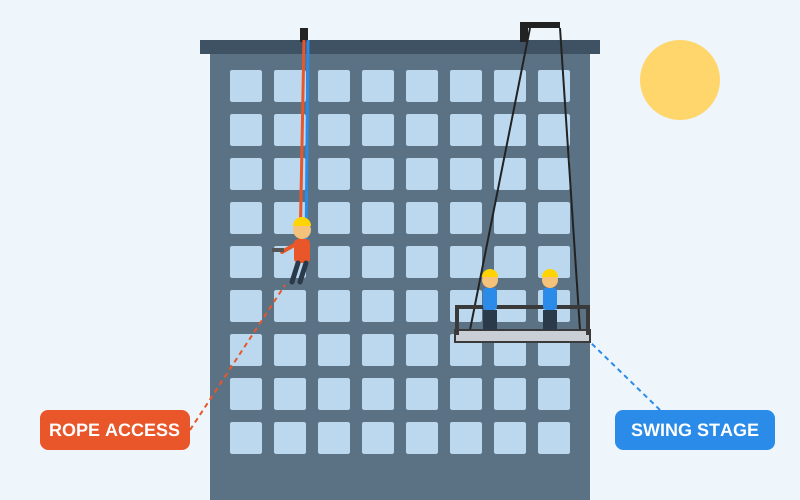
When it’s time to clean the windows, caulk or inspect the facade of a high-rise, property managers and condo boards usually face the same question: should the work be done by rope access or from a swing stage? Both are safe, proven methods when done by trained crews – but they suit different buildings and different jobs. Here’s how they compare.
What Is Rope Access?
Rope access technicians descend the face of the building on two independent ropes – a working line and a safety line – each attached to certified roof anchors. Technicians are trained and certified under international programs such as IRATA or SPRAT, and work in teams with a supervisor on site. Each technician cleans a vertical “drop” of windows from top to bottom, then moves over to the next.
What Is a Swing Stage?
A swing stage (suspended platform) is a motorized platform hung from the roof on wire ropes, raised and lowered by hoists. Workers stand on the platform, tied off to independent lifelines, and work across a wider section of the facade at once. Swing stages need roof davits or outrigger beams and more time to rig and move.
Side-by-Side Comparison
Setup time: Rope access rigs in minutes; a swing stage can take hours to install and relocate.
Speed on window cleaning: Rope access is usually faster for routine cleaning, since drops move quickly.
Cost: Rope access is often more cost-effective for regular maintenance thanks to less equipment and faster setup.
Heavy or long-duration work: Swing stages are better when crews need to carry materials, tools or replacement glass.
Hard-to-reach areas: Rope access handles setbacks, curved facades, overhangs and tight spots that a platform can’t reach.
Impact on residents: Rope access has a smaller footprint on the roof and at ground level.
When Rope Access Makes Sense
Rope access is a great fit for routine window cleaning, caulking and sealant repairs, spot repairs, inspections, and buildings with complex shapes. Because it’s quick to rig, it’s also ideal for small jobs that don’t justify setting up a platform.
When a Swing Stage Makes Sense
A swing stage is the better choice for large-scale facade work such as full recaulking of a building, glass or panel replacement, or projects where crews need to bring heavy materials and work in the same area for an extended period. It is also common on buildings designed with davit systems for platform access.
What Your Building Needs Either Way
Both methods depend on your building’s roof anchor system. In Ontario, exterior window cleaning is regulated under the Window Cleaning Regulation (R.R.O. 1990, Reg. 859), which sets requirements for equipment, anchors and work procedures. Before any work begins, a reputable contractor will review your roof anchor drawings and inspection records and confirm which access methods your building supports. If your anchors are overdue for inspection, that needs to be addressed first.
How to Choose
For most condominium and commercial buildings in the GTA, rope access is the most efficient option for regular window cleaning and light maintenance, while a swing stage is the right tool for heavy, long-duration projects. Many buildings use both: rope access for spring and fall cleans, and a swing stage when a major restoration project comes up.
Not Sure Which Method Fits Your Building?
PrimeTech Building Services has been working on high-rise buildings across the Greater Toronto Area for over 18 years. Our technicians are certified in IRATA/SPRAT rope access, Suspended Access Equipment and Working at Heights, so we can recommend – and deliver – the method that’s safest and most cost-effective for your property. Learn more about our window cleaning, caulking and health and safety program.
Call 647-558-0620 or email info@primetechltd.ca for a free estimate.